A 3,900-square-foot house on North Bayshore Drive went for $600,000 in 1996. It was built in 1969 and has four bedrooms, a pool, a treehouse, a music studio and a 140-year-old gazebo. In 2025 it sold for $16 million, a Morningside record at the time. In 2026 it sold again, this time for $24.1 million, to a buyer who The Real Deal reported plans to build a new house on the site.
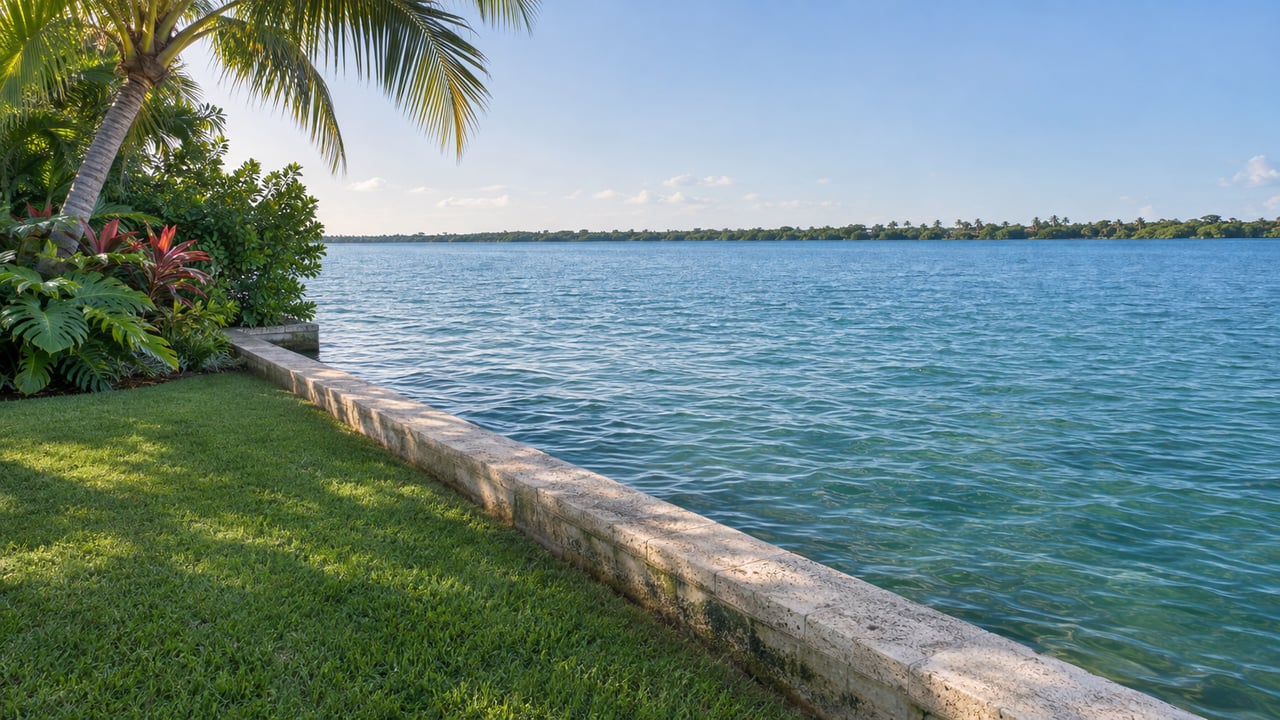
So the house that set the record will probably be torn down. That tells you what the $24.1 million bought: nearly an acre, a dock and 125 feet of Biscayne Bay. If you're comparing Miami's Upper Eastside with the Grove, the Gables or Miami Beach, start here. Bay frontage in Morningside and Bay Point trades as its own asset, and it has a large effect on the headline figures you've probably already seen.
Divide by the Seawall, Not the Square Footage
The usual per-square-foot math falls apart on 5725 North Bayshore Drive. Divide $24.1 million by the house's 3,900 square feet and you get about $6,180 a foot. That number describes something the buyer doesn't plan to keep.
Waterfront frontage is the better divisor. At $24.1 million for 125 feet, the 2026 Morningside sale works out to about $193,000 per foot of shoreline. Bay Point's record from January 2025, the sale of 4445 Sabal Palm Road for just over $85 million, brought 1.7 acres and 400 feet of bay frontage, or roughly $212,500 per foot. One estate cost more than three times as much as the other, yet the two land on similar prices per foot of seawall. Both buyers seem to have priced the same scarce thing at about the same rate.
The other 2026 record follows the same pattern from the house side. In July 2026, 790 Lake Road in Bay Point sold for $27.3 million, which The Real Deal reported as a record of nearly $4,300 per square foot. The Miami Herald put the price at more than $27 million, called it Bay Point's priciest sale of the year to that point, and listed a private dock, a rooftop terrace, an infinity pool and a wine cellar. A price near $4,300 a foot for a finished house in a gated enclave makes sense once the water is counted as part of what was sold.
Why the Record Was Set Off-Market
The way the 2026 Morningside sale came together shows what scarcity looks like. The buyer's agents told The Real Deal that they first showed their client properties in Miami Beach and the Venetian Islands. They found the asking prices there "extremely high" per square foot, and only then did they show him Morningside. They then contacted potential sellers and negotiated with an owner who "had no intention of selling" for months. One of the agents called it a "name-your-price situation."
The same report said a shortage of waterfront land and homes has led a number of buyers' agents to approach owners directly. That affects how you read the market. If the most wanted lots change hands through private approaches, the public listings in Morningside and Bay Point at any moment show only part of what is trading.
It also explains the jump from $16 million to $24.1 million in about a year. The 2025 price was itself a record, beating the $14 million waterfront purchase from 2021 that had stood as Morningside's previous high. When a buyer has to coax an owner who wasn't selling, the seller sets the price, and the last record becomes a floor rather than a ceiling.
How a Few Big Closings Bend a Zip-Level Average
The same logic matters for anyone shopping below the record tier, because in a thin market a few big closings can move a zip-level average a long way. The Miami Realtors third-quarter 2026 single-family report, released October 16, 2026, shows the effect in two of Miami's zip codes.
| Q3 2026, single-family | 33137 | 33138 |
|---|---|---|
| Closed sales | 16 | 63 |
| Median sale price | $1,795,000, up 43.3% year over year | $1,467,500, up 19.3% |
| Average sale price | $4,113,688, up 48.3% | $1,618,647, up 0.8% |
| Months of supply | 7.1 | 5.3 |
| Active listings | 38 | 99 |
In 33137, the third-quarter 2026 average was about 2.3 times the median. With only 16 sales in the quarter, one or two closings at the top can drag the average up while the middle sale hardly moves. In 33138, with 63 sales, the average sat only about $150,000 above the median for the same quarter, and it barely changed from a year earlier. That's what a zip-level price looks like when no small group of extreme trades dominates it.
Supply points the same way. In the third quarter of 2026, 33137 had 7.1 months of single-family supply across 38 active listings, a pace that gives buyers of listed homes time to compare. That's a different market from the waterfront tier, where by The Real Deal's account agents are knocking on doors. A quarterly average that mixes both kinds of sale describes neither.
Two Enclaves, Two Kinds of Scarcity
Morningside and Bay Point share a shoreline, but other things make each one scarce, and both affect what a buyer is paying for.
Bay Point's appeal, as the Miami Herald reported it, rests on the water and the gate. The buyer's representative pointed to the gate and to how close the enclave is to the Design District and downtown, and the Herald noted that the private roads are open only to residents and guests.
Morningside's identity is older. The City of Miami lists the Morningside Historic District as locally designated since 1984 and on the National Register since 1992. Miami-Dade's 2026 assessment report also lists a Morningside Security Guard District, one of the county's special districts. The 2026 buyer at 5725 North Bayshore Drive plans to build a new house on a bayfront lot in a neighborhood that has held its historic designation for more than four decades. Those decades of continuity are part of what $24.1 million buys here.
Reading a Morningside Comp Sheet
All this changes how to read a comp sheet here. A bayfront sale and an interior-street sale in Morningside fall in the same neighborhood but are different products. Most of the bayfront price pays for shoreline, and the house may not outlast the sale, while the interior-street price pays for the house and its lot. A figure that averages the two describes neither.
The same idea runs through our posts on Pinecrest, where the acre under the house drives value, and on Coconut Grove, where the trees on an older lot affect how much a rebuild is worth. Across Miami's established neighborhoods, the part of a property that can't be reproduced usually sets its price. In Morningside and Bay Point, that part is the frontage.
Quick Answers
Is the $24.1 million Morningside sale a fair comp for a non-waterfront home in the neighborhood? No. The buyer paid for nearly an acre with 125 feet of bay frontage and a dock, and plans to build new. An interior-street home is best measured against other interior-street sales.
Why can a zip code's average rise much faster than its median? When a quarter has few sales, a couple of very high closings move the average. In third-quarter 2026, 33137 recorded 16 single-family sales, with an average of $4,113,688, up 48.3% year over year, against a median of $1,795,000.
Do the best waterfront lots show up on the market? Not always. The Real Deal reported that the 2026 Morningside record traded off-market after the buyer's agents approached an owner who wasn't selling, and that tight waterfront inventory has more agents contacting owners directly.
If you're weighing a Morningside or Bay Point home against Coconut Grove or the Gables, the price per foot of seawall and the interior-street comps say more than any headline record. Hidy Homes Team will go through the comps with you, separate the bayfront trades from the interior streets, and tell you which side of that split your budget is shopping in. When you're ready to walk Morningside's streets, schedule a showing with us.